Observation geometry
Reconstruct line of sight, range uncertainty, camera motion, parallax and angular rate before inferring speed or acceleration.
 Report a sighting
 This programme studies unusual aerospace observations through reproducible case reconstruction. QFMT is one proposed interpretation to test—not a conclusion imposed on the evidence.
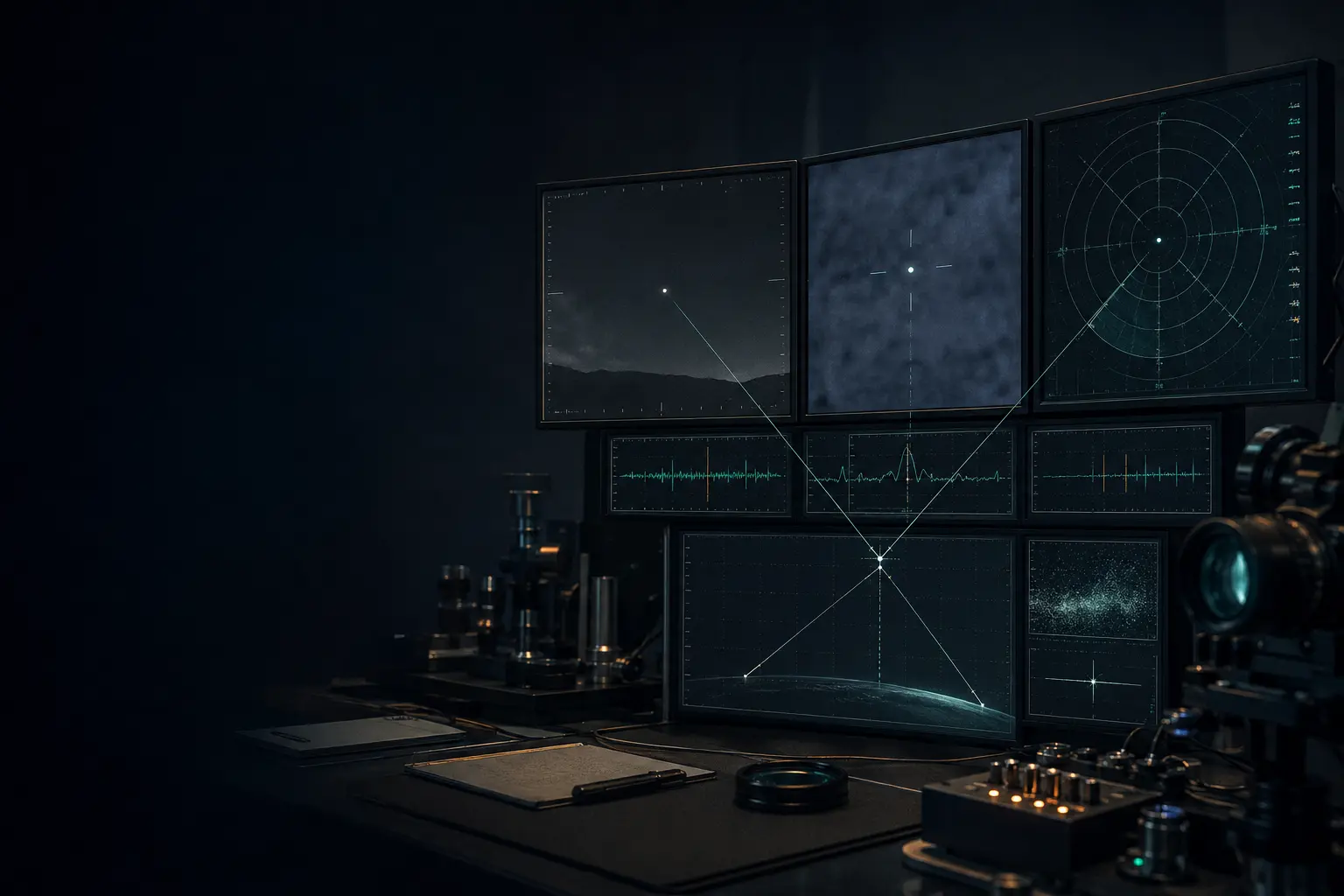
Time alignment, calibration, line of sight and platform motion come before performance claims. Contradictions between sensors are findings to explain—not details to discard.
No single photograph, witness or sensor can carry an extraordinary conclusion alone. The strongest cases combine independent records with transparent analysis.
Reconstruct line of sight, range uncertainty, camera motion, parallax and angular rate before inferring speed or acceleration.
Align optical, infrared, radar, acoustic, environmental and witness records on one reliable timeline.
Look for measurable electromagnetic, atmospheric, thermal or gravitational changes without treating coincidence as causation.
Record perception, physiology and memory conditions while treating witnesses respectfully and testing ordinary explanations.
Preserve originals, metadata, hashes, sample provenance and custody before destructive testing or public circulation.
Compare reporting routes, archive practice, oversight, classification and scientific access across jurisdictions.
The same staged method applies whether a report looks ordinary or extraordinary.
Preserve original media, metadata, precise context, witness accounts, hashes and custody.
Align clocks, viewing geometry, weather, astronomical data, aircraft, satellites and platform motion.
Actively test balloons, aircraft, drones, birds, celestial objects, atmospheric effects and sensor artefacts.
State whether a case is resolved, probably resolved, data-deficient or genuinely anomalous—without forcing an origin.
Only then compare a pre-registered QFMT prediction against the same data and a conventional control model.
These are research hypotheses generated from QFMT. None has been established as the cause of any UAP case.
Apparent rapid translation, unusual turns or time-gradient reports.
Independent sensors should agree on geometry and timing after parallax, range and platform motion are reconstructed.
The effect disappears when range, camera motion, processing or ordinary traffic is correctly modelled.
Apparent shape change, boundary shimmer, darkening or partial visibility.
A real boundary effect should produce consistent, wavelength-dependent signatures across independent calibrated cameras.
Compression, autofocus, glare, bokeh, atmospheric seeing or sensor processing reproduces the appearance.
Repeated path selection or movement that appears anticipatory rather than ballistic.
Pre-registered analysis should find repeatable trajectory structure beyond air routes, observer selection and environmental constraints.
The pattern is no stronger than matched conventional traffic or disappears in blinded analysis.
Reported interference, sensor drop-out or frequency-linked responses.
Calibrated instruments should capture time-aligned, repeatable signals above background with controls and complete raw data.
The signal follows local transmitters, equipment faults, aliasing, harmonics or analysis choices.
That statement protects the research rather than weakening it. A useful theory must risk being wrong, publish null results and outperform simpler explanations on pre-defined measurements.
Reports remain classified case by case. “Unresolved” means the available evidence does not currently support a confident identification; it does not mean QFMT, extraterrestrial origin or non-human technology.
Witnesses can submit original material through the structured reporting system. Researchers can contact the project about sensor analysis, physics, statistics, human factors, archival work or critical review.